
Contents
Overview
The concept of Kundalini, meaning 'coiled one' in Sanskrit, traces its origins to ancient India, finding early articulation in the Vedic and Upanishadic literature, though its systematic exploration is most prominent in Shaiva Tantra and Shaktism. Texts like the Śvetāśvatara Upanishad (circa 400 BCE) allude to a subtle energy within the body, while later Tantric scriptures, such as the Kularnava Tantra (estimated between 7th-11th centuries CE), explicitly detail Kundalini's coiled form at the base of the spine and its potential for spiritual ascent. The Hatha Yoga Pradipika (15th century CE) further integrated Kundalini awakening into yogic sadhana, solidifying its place in the broader spectrum of Indian spiritual practices. This energy is often personified as the divine feminine Shakti, the primordial cosmic energy that animates the universe.
⚙️ How It Works
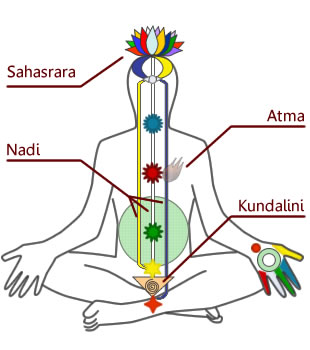
Kundalini is understood as a latent spiritual force, often visualized as a serpent coiled three-and-a-half times at the Muladhara chakra, the root energy center at the base of the spine. Its awakening is typically initiated through disciplined yogic practices, including pranayama (breath control), dharana (concentration), and dhyana (meditation), often guided by a guru. The process involves the subtle energy, prana, flowing through the Ida and Pingala nadis, eventually clearing the central Sushumna nadi. As Kundalini rises through the chakras—Muladhara, Svadhisthana, Manipura, Anahata, Vishuddha, Ajna, and Sahasrara—it purifies and activates each center, leading to progressively higher states of consciousness, culminating in samadhi or union with the divine at the Sahasrara chakra.
📊 Key Facts & Numbers
The concept of Kundalini is associated with a potent, often electric, feeling running along the spine, described by some as a distinct electric current. While precise quantification is elusive, practitioners report intense physiological and psychological phenomena during awakening. Reports suggest that over 50% of individuals practicing advanced Kundalini Yoga under qualified guidance experience significant energetic shifts. The chakras are often described as having specific petal counts, with Muladhara having four, Svadhisthana six, Manipura ten, Anahata twelve, Vishuddha sixteen, Ajna two, and Sahasrara a thousand petals, symbolizing the increasing complexity and refinement of consciousness as Kundalini ascends. The number of nadis (energy channels) is often cited as 72,000, with Ida, Pingala, and Sushumna being the most crucial.
👥 Key People & Organizations
Key figures in the dissemination of Kundalini teachings include Paramahansa Yogananda, whose book Autobiography of a Yogi introduced many Westerners to these concepts, and Yogi Bhajan, who founded 3HO Kundalini Yoga in the late 1960s, popularizing a specific style of Kundalini practice globally. Within Hinduism, figures like Adi Shankara and various Tantric masters have expounded on Shakti and its manifestation. Organizations such as the Kundalini Research Foundation and 3HO International (now known as Akhara) have played significant roles in organizing teachings and research, though the latter has faced controversies regarding its founder.
🌍 Cultural Impact & Influence
Kundalini's influence extends far beyond its Indian origins, significantly impacting global spirituality and wellness movements. The practice of Kundalini Yoga as taught by Yogi Bhajan became particularly popular in the West from the 1970s onward, with dedicated centers established in numerous countries. The concept has also been adopted and adapted within New Age circles, often integrated with other spiritual modalities. Its imagery, particularly the coiled serpent, has become an iconic symbol of spiritual awakening and transformation in popular culture, appearing in art, literature, and media, sometimes divorced from its original Hindu context.
⚡ Current State & Latest Developments
In the contemporary landscape, Kundalini remains a vibrant and evolving spiritual force. Kundalini Yoga continues to be practiced globally, with ongoing efforts to refine its teachings and address historical controversies surrounding its founder, Yogi Bhajan. Research into the physiological and neurological effects of Kundalini experiences is also gaining traction, with studies exploring brainwave patterns and subjective reports of practitioners. New interpretations and applications of Kundalini energy are emerging, sometimes blending with modern psychology and somatic practices, indicating its continued relevance and adaptability in the 21st century.
🤔 Controversies & Debates
The interpretation and experience of Kundalini are subjects of considerable debate. Skeptics often attribute Kundalini phenomena to psychological factors, psychosomatic responses, or even neurological events rather than a distinct spiritual energy. Critics of Kundalini Yoga practices, particularly those popularized by Yogi Bhajan, point to allegations of abuse and cult-like dynamics within 3HO. Furthermore, the potential for 'false awakenings' or intense, disorienting experiences (sometimes termed 'Kundalini syndrome') raises questions about the safety and efficacy of unsupervised practice. The very nature of Kundalini—whether it is a literal energy, a metaphor, or a psychological construct—remains a point of contention among scholars and practitioners alike.
🔮 Future Outlook & Predictions
The future of Kundalini exploration likely lies in a more integrated approach, bridging ancient wisdom with modern scientific inquiry. Continued research into the neurobiology and physiology of Kundalini experiences could provide empirical validation or alternative explanations, potentially demystifying aspects of this potent energy. As global interest in consciousness and spiritual development grows, Kundalini may become a more widely recognized pathway to inner transformation, though its integration will likely involve navigating the complexities of its diverse interpretations and historical controversies. The potential for cross-cultural dialogue between traditional yogic lineages and contemporary spiritual seekers promises to enrich our understanding of this profound inner power.
💡 Practical Applications
Kundalini practices are primarily applied for spiritual growth and self-realization, aiming to achieve states of heightened consciousness and liberation. For practitioners, awakening Kundalini is a path to purifying the mind and body, dissolving karmic imprints, and realizing one's true divine nature. In a more secular context, elements of Kundalini-inspired yoga and meditation are used for stress reduction, enhanced focus, and emotional well-being. The techniques, such as specific pranayama exercises and mantra chanting, are often adapted for therapeutic purposes, aiming to balance the nervous system and promote overall vitality, though these applications are distinct from the traditional goal of spiritual liberation.
Key Facts
- Category
- mysticism-inner-life
- Type
- concept